
Showing posts with label comic novel. Show all posts
Showing posts with label comic novel. Show all posts
Tuesday, 12 April 2022
Saturday, 26 February 2022
The Woman from Uruguay by Pedro Mairal
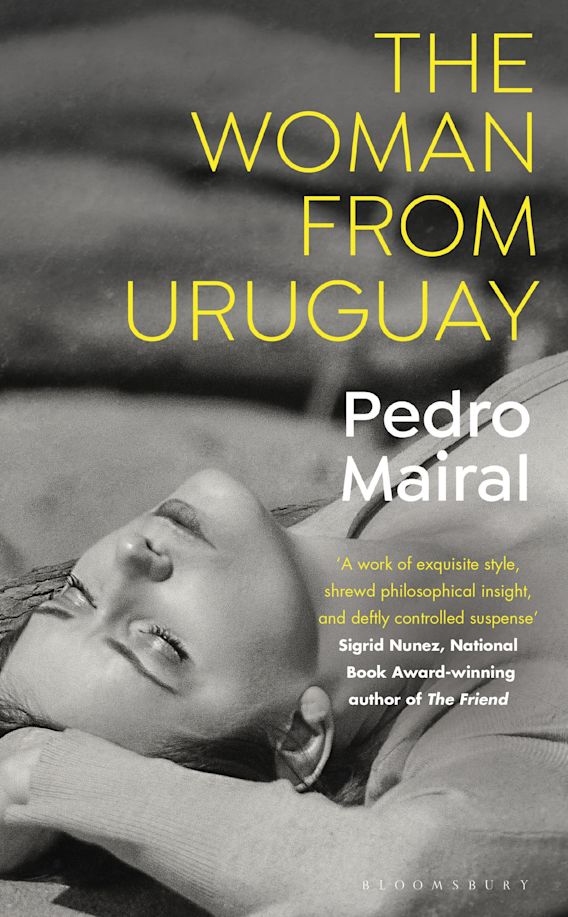
The Woman from Uruguay
by Pedro Mairal
Translated by Jennifer Croft
Wednesday, 5 January 2022

Monday, 27 December 2021

Sunday, 5 July 2020
The Career of Nicodemus Dyzma by Tadeusz Dolęga-Mostowicz

The Career of Nicodemus Dyzma
by Tadeusz Dolęga-Mostowicz
(translated from the Polish by Ewa Małachoska-Pasek and Megan Thomas)
A review
Sunday, 10 May 2020

Sunday, 26 April 2020

Sunday, 25 August 2019
Divine Comedy: "Milton in Purgatory" by Edward Vass

Divine Comedy
A review of "Milton in Purgatory" by Edward Vass
A Fairlight Modern novella
Thursday, 4 July 2019
Love in the GDR: "The New Sorrows of Young W." by Ulrich Plenzdorf

Love in the GDR...
The New Sorrows of Young W. by Ulrich Plenzdorf
(translated by Romy Fursland, Pushkin Press)
Monday, 18 March 2019
Euro Vision : The Capital by Robert Menasse (translated by Jamie Bulloch)

"The Capital" by Robert Menasse
Translated by Jamie Bulloch
A book review
Robert Menasse’s Die
Hauptstadt, winner of the 2017 German Book Prize, has recently being
published by MacLehose Press in an English translation by Jamie Bulloch. In this incarnation, the novel’s title is
rendered as The Capital. This name, of course, a faithful and literal
translation from the German, but I wonder whether it was also meant as a
tongue-in-cheek reference to Karl Marx’s epic tome. Indeed, political and economic theories also
loom large in Menasse’s Capital, except
that they are presented within the context of a zany novel about the workings
of the European Commission.
Die
Hauptstadt has been described as
the first great novel about the European Union.
It could well be the case. I
don’t profess to be some expert in Continental literature, of course, but the
only other novel I know which uses the European Commission as a backdrop is “What happens in Brussels stays in Brussels”
by the Maltese author Ġuże’ Stagno. And
that’s more a satire on Maltese politics and the Maltese representatives in the
EU, than a novel on the European institutions themselves.
Menasse’s work takes a wider view. Its central plot element is a “Big Jubilee
Project” which is being organised by the Commission as a celebration of the
anniversary of its founding. Ambitious
EU official Fenia Xenapoulou hopes that this will be an occasion to improve the
image of the Commission, whilst providing her with her big break. Fenia’s Austrian assistant Martin Susman comes
up with the noble idea of roping in Holocaust survivors, as a reminder that the
European Union was built to ensure that Auschwitz would “never happen again”. Unsurprisingly,
as the organizers will discover to their chagrin, national interests and
behind-the-scenes lobbying make the success of such an ambitious celebration
unlikely.
Much as I enjoyed this novel, I must say that it took me
some time to finally get immersed in it.
This is certainly not the fault of the translation – I’ve previously
enjoyed Bulloch’s translations of The
Mussel-Feast and Look Who’s Back,
and as in those novels, The Capital
is rendered in prose that is idiomatic and flowing. I believe the problem is more with its sheer
number of characters (a recent theatrical adaptation involved 7 actors
playing about 20 roles) – in the initial chapters especially, I thought that an
introductory dramatis personae would
have been helpful as a guide to the somewhat bewildering international cast.
Another issue is with the proliferation of seemingly
unrelated subplots involving, amongst other narrative complications: a pig on
the loose in Brussels; a retired Professor preparing to deliver a final,
memorable speech; a Holocaust survivor coming to terms with his impending
death; a number of potential, never-fully-realised love stories and, more
weirdly, a crime investigation which seems to have been borrowed from a Dan
Brown thriller. More frustratingly, some
of these loose ends are never tied up.
In other words, The
Capital is a sprawling novel which could have done with some
tightening. However, its polyphonic
narrative is, in itself, a good metaphor for the European Union, this patchwork
of nations and cultures which, somehow, managed to build a future of hope from
the cinders of a continent ravaged by war.
Indeed, this novel, despite its several comic and surreal elements,
provides Menasse with the springboard to present his views on the European
Union. Despite the evident shortcomings,
the bureaucracy and the backstabbing which seem to characterize the working of
its institutions, especially the Commission, the central idea(l) of the EC remains
a laudable one – the creation of a supra-national body to keep extreme
nationalism in check, in order to ensure that the horrors of the 20th Century
do no happen again. In the age of
Brexit and strident populism, its themes urgently relevant.
Kindle Edition, 432 pages
Published February 21st 2019 by MacLehose Press
***
Auschwitz – Never Again, is the mantra that underlines Menasse’s The Capital,
revealing an earnest and burning message at the heart of what might seem ‘just’
a comic romp. That is why I have no qualms
about pairing this novel with a cult work by Polish composer Henryk Górecki (1933-2010) –
his Third Symphony, also known as “The Symphony of Sorrowful Songs”. Premiered
in April 1977, the symphony marked a clear departure from the composer’s usual
dense and avant-garde style, in favour of a modal and emotionally direct
language. Its second movement sets a prayer
scrawled by an 18-year old prisoner on the wall of a Gestapo camp in Zakopane. This video is taken from the documentary Holocaust,
featuring a performance recorded at Auschwitz.
Harrowing doesn’t start to describe this.
Sunday, 3 February 2019
Family Comedy : "The Altruists" by Andrew Ridker

Charity begins at home... A review of Andrew Ridker's "The Altruists"
I do not envy comic
novelists. Besides the challenges facing
any novel writer, they have to elicit a smile, chuckle or smirk from their
readers at regular intervals. Then, if and
when they get it right, they face the risk of seeing their work dismissed as
‘(s)light’ fare. A case in point, in my
opinion, was Andrew Sean Greer’s Less, which I greatly enjoyed and which
I think really did deserve the Pulitzer, but which was slated in some quarters,
including by friends and reviewers whose opinion I greatly respect.
It is therefore great
news that a fresh talent has now joined the ranks of comic novelists. Andrew Ridker was born in 1991, and his debut
novel The Altruists is published later this year. Admittedly, on the
cynicism/bleakness scale, this novel is closer to Richard Ford than to Andrew
Sean Greer, which might make it more palatable to the literati. Indeed, it’s already attracting glowing
advance reviews. As for me, I admired
most of it, although I find it harder to actually like it.
The protagonists of The
Altruists are the Alters, a Jewish middle-class family from St Louis. The mother, Francine, haunts the novel,
despite being dead for most of it. Indeed, it is her inheritance which serves
as the catalyst of the plot. Incensed at
the fact that her sixty-something professor husband Arthur has taken up a much
younger lover whilst she is dying of cancer, Francine bequeaths a secret
fortune to her two children, Ethan and Maggie.
Faced with the prospect of losing his girlfriend and also his heavily
mortgaged house, Arthur invites his children back to St Louis for a
reconciliatory weekend, hoping to convince them to bail him out. But Ethan and Maggie have their own
problems. Ethan (whose homosexuality
Arthur has never quite accepted) is out of a job, and is now living off his
mother’s money in Brooklyn, whilst trying to sort out his messy love life. On her part, Maggie is a hard-headed would-be
altruist, whose obsession with causes and ideals often leads her to actually
overlook the needs of the people who surround her. Although Arthur’s plans seem
to be failing miserably (but quite entertainingly for us readers), they do lead
the Alters to come to term with their history and to understand that they are
possible more like each other than they like to think.
To be honest, I found it
hard to symphatize with any of the characters, who seemed to have few, if any,
redeeming features. There are likeable
rogues, but Arthur is certainly not one of them. And his children are, frankly, chips off the
old block. This ultimately detracted
from my enjoyment of the novel. At the
same time, however, there is much that is brilliant about The Altruists
– it is an undeniably insightful work, it has some crisply humourous dialogue,
and memorable set pieces. I particularly
enjoyed the final showdown between the Alters and Arthur’s young lover, and the
Zimbabwe episode feels like something out of Evelyn Waugh.
Hardcover, 320 pages
Expected publication: March 7th 2019 by Jonathan Cape
Subscribe to:
Posts (Atom)


