Horror Autofiction - "I Always Find You" by John Ajvide Lindqvist
A review
Some years back I had enjoyed - with some
reservations - Lindqvist's first and best novel "Let the Right One
In". It was that which led me to try his latest book to be published in
English (in a translation by Marlaine Delargy) - I Always Find You - the second
instalment in the "Places" trilogy. Unfortunately, it left me with a
sour taste, a reminder that in-your-face horror is, alas, not for me... Which,
of course, does not mean that there's not much for others to enjoy in this
book.
Lindqvist has often been compared to Stephen King
and one can see certain parallels with the American master of horror. Lindqvist
is as much concerned with the realist/social aspects of his story as with the
supernatural ones. In this case, the protagonist-narrator is a fictionalised
version of the author himself, who is recalling events which occurred in 1985,
as well as a disturbing incident from some years before that. In the mid-80s,
the narrator/author was just 19 years old and starting out as a young
showman/magician. He moves into a small and decrepit flat in a run-down
apartment complex in Stockholm and the 'horrors' he has to face are the very
real daily challenges faced as a teenager coming to terms with adult life. A
novel does not need to go far back to count as convincing historical fiction
and, in this case, judiciously-placed cultural and historical references
(Depeche Mode, skinheads, the assassination of Olof Palme) take us, very
effectively, back to 80s Stockholm. One also gets the impression that mixed
with the distaste for the sordidness which city life could bring, there's also
a vague sense of nostalgia.
The supernatural elements start, literally, with
drainage problems. The apartment condomini share a communal laundry and
bathroom and, out of the blue, an out-of-order sign appears on the bathroom
door. Soon after, cataclysmic and ominous signs manifest themselves - birds
fall out of the sky, John suffers from a constant claustrophobic feeling and
the neighbours start behaving strangely. And the bathroom seems to beckon.
What follows is hard to describe without giving
away much of the plot. And so I will leave any intrigued readers to discover
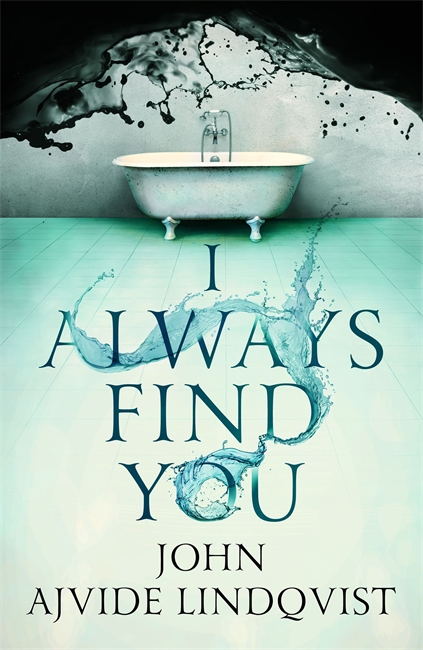
for themselves the strangeness which lurks in the cover's bathtub. Suffice it
to say that it is both splendid and bizarre, and evidence of the author's wild
flights of the imagination. However, it also leads to some bloody and, at least
to me, repulsive scenes and it is here that the book started to lose me.
Lindqvist manages to give even the more outlandish
aspects of his book a social and political underpinning. It is an interesting
approach even it sometimes gives rise to rather preachy monologues.
Overall, a mixed bag, which gives a horror twist
to the "autofiction" genre.
Published September 20th 2018 by riverrun