
Showing posts with label Eden Book Society. Show all posts
Showing posts with label Eden Book Society. Show all posts
Sunday, 6 September 2026
Thursday, 6 August 2026

Friday, 3 July 2026

Monday, 29 June 2026
An Attempted Bibliography of the Works of Barbara Livesey by Stephen George Wallis

An Attempted Bibliography
of the Works of Barbara Livesey
by Stephen George Wallis
Sunday, 5 September 2021

Saturday, 6 February 2021
Tuesday, 7 July 2020
"Plunge Hill: A Case Study" by J.M. McVulpin

Plunge Hill: A Case Study
by J.M. McVulpin
The return of the Eden Book Society series
Monday, 29 July 2019
Hare-raiser: Andrew Michael Hurley returns with "Starve Acre"

Hare-Raiser
"Starve Acre" by Andrew Michael Hurley
A review
Saturday, 6 April 2019
Dead and buried: "Starve Acre" by Jonathan Buckley

Starve Acre by Jonathan Buckley
An Eden Book Society Edition
Book review
Thursday, 14 March 2019
White Coat Syndrome : "A Dedicated Friend" by Shirley Longford

Shirley Longford's "A Dedicated Friend"
A review of the third horror novella
in the Eden Book Society Series
The “Eden Book Society” series published by
Dead Ink Press reaches its third instalment with A Dedicated Friend,
purportedly written in the 1970s by the little-known author Shirley
Longford. “Purportedly” because,
as I have had the occasion to explain in my review of Judderman, the
Eden Book Society project is based on an intriguing meta-fictional frame
narrative. The “Society” is, itself,
part of this overarching story, an imaginary publishing house allegedly set up
in 1919, which used to issue horror novellas for a private list of subscribers. The books in the series have, in reality,
been commissioned by Dead Ink Press from leading contemporary British horror writers: Andrew Michael Hurley,
Alison Moore, Aliya Whiteley, Jenn Ashworth and Richard V Hirst, Sam Mills and
Gary Budden.
However, they’re being published as if they are part of the back catalogue of
the Eden Book Society, a reprint of novellas originally issued in 1972.
This poses an intriguing narrative challenge for the commissioned writers, who are faced with the daunting task of recreating the style of 70s horror novels and evoking the atmosphere of the decade, whilst remaining relevant to present-day readers with contemporary sensibilities.
What is also becoming evident as we
reach midway in this “year of horror” (and may there be many more!), is that
despite what appear to be strict stylistic parameters, the novellas take an
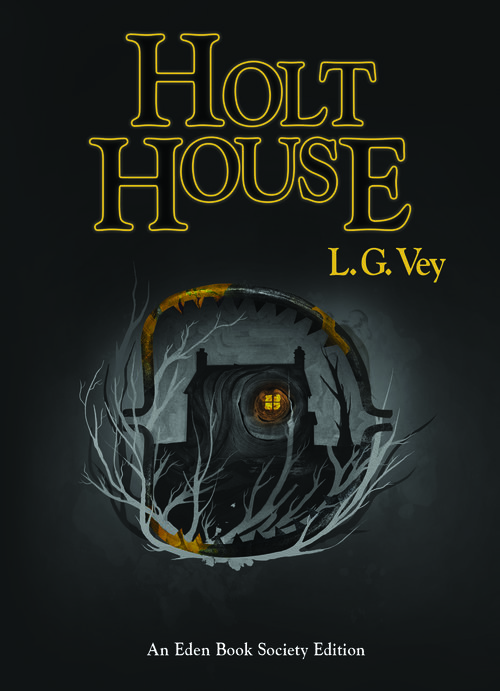
unexpectedly varied approach. Holt House, the first instalment in the series, combined folk and existential horror, whilst its
follow-up Judderman
was a dark piece of “London Gothic” – urban noir underpinned by a
Gary-Buddenesque fascination with Deep Time. A Dedicated Friend is a weird little beast. Of the three novellas it is the most
understated, and certainly the one with the least “supernatural” (for want of a
better word) overtones. It is also,
possibly, the most unsettling.
The story starts with Daisy being admitted to
hospital after volunteering to donate a kidney to her aunt. In the 70s, organ transplants were still
innovative – and relatively risky – operations and this already gives the
novella a certain frisson. Things
get weirder, however, when Daisy, eager to return home after the operation, is
kept on at the hospital for reasons which are at best vague, at worst
worrying. In the meantime, her old childhood friend
Eliza takes it upon herself to turn up at the hospital on a daily basis,
bringing news about Daisy’s husband and children, who always seem to have a
good excuse not to visit.
What I particularly like about this series is
that its horror is less of the gory type and more of a subtler ‘psychological’
nature. A Dedicated Friend is a
perfect example. Whilst it has some
elements of body horror, what really gnaws at you as the pages progress is a
growing sense of dread, hopelessness and claustrophobia. The
novella is particularly well-judged in its attention to little details which
make it more credible. For instance, I
liked the ingenious way in which the author fills us in about Daisy’s family
life, despite the fact that all the action takes place within the hospital
walls. “Sensitive” young Alfie is
particularly well-drawn even though he never actually appears in the story.
The playful biography of Shirley Longford at
the start of the book tells us that this obscure writer cut her teeth on
children’s books and that, even after she turned to horror, “she hoped to write
romances for Mills & Boon”. On
finishing the novella, these biographical details take on a new significance: The
Dedicated Friend may be a horror novella, but it also uses its
protagonist’s relationship with her husband and children to probe the fragility
of familial ties.
Is the Eden Book Society project the best thing
happening in horror right now? Based on
what I’ve read so far, I’d be ready to put my money on it.
Thursday, 11 October 2018
London Incognita : The Eden Book Society presents D.A. Northwood's "Judderman"

D.A Northwood's Judderman
The Eden Book Society lives again
Judderman is the second book in the "Eden Book
Society" series published by Dead Ink Press. I was toying with the idea of playing along
with the meta-fictional premise of the series and providing a biography
of its author D.A Northwood, the obscure writer who “disappeared from his Tottenham flat
in 1981, at the age of 38”. Frankly, however, I think it does greater justice to the project
to actually explain the 'conceit' which underpins it. Here it is, in brief.
The (fictional) "Eden Book Society" was set up in 1919, publishing horror novellas for a private list of subscribers. Eden books were elusive things - written under a pseudonym, available only to a select few, occasionally turning up in jumble sales or unexpected locations. Dead Ink Press, the publishing house behind this literary experiment, purportedly acquired the back catalogue of the Society, and will reprint the novellas sequentially, starting from 1972. In actual fact, the books are penned by a group of specially commissioned writers. The list sounds like a roll-call of leading contemporary British horror writers: Andrew Michael Hurley, Alison Moore, Aliya Whiteley, Jenn Ashworth and Richard V Hirst, Sam Mills, Gary Budden.
The brilliance of this project lies in the fact that the very concept behind it creates an aura of mystery and suspense. And then there's that meta-literary playfulness which is typical of classic Gothic. With the novels purportedly originally issued in 1972, the authors have to succeed in an ambitious double-act : evoking the style of 70s horror whilst taking us back to the atmosphere of that decade. It's a sort of historical scary fiction.
Where Holt House, the first instalment in the series, combined folk and existential horror, Judderman falls squarely within the "urban weird" genre and, more specifically, the sub-category of London Gothic. The story revolves around brothers Gary and Daniel Eider, who are trying to catalogue a 'peripheral' city, one rich in urban myth and esoterism, a shadowy place they refer to as "London Incognita". Amongst the dying embers of a decadent society, a new ghoul-like figure is sighted. It's the Judderman, a malevolent figure which seems to be made out of the evil which is gripping the city. Daniel follows this monster into oblivion. He goes missing, leaving Gary to roam in London’s occult underworld in a bid to solve the mystery of his brother's disappearance.
My first impression upon reading the novella (most appropriately, on a flight to London), was that this could have been a joint effort of Peter Ackroyd and Iain Sinclair, after a night smoking marijuana and listening to early Pink Floyd. "Judderman" is, like the work of these authors, strongly rooted in 'psychogeography', the quasi-mystical idea that urban spaces hold and summon a collective historical memory. Indeed, Daniel and Gary's feverish visions often involve images of old, ancient and even prehistoric London. Interestingly, the novella manages to combine the very real horrors which gripped the 70s (unemployment, drugs, racial and sectarian violence, IRA bombings) with imagined ones stemming from urban myth (such as monsters living in unused Underground stations) - a hellish marriage of London Cognita and Incognita. And to add more flavour to the meta-mix, there are extracts from lost diaries, stories within stories, quotes from fictional authors.
Who's behind this unsettling literary concoction? Perhaps the choice of Gary as one of the protagonist's names is a clue. But one can never be too sure. This is the Eden Book Society after all...
***
If I had to choose an album to accompany the novella, it would be Portishead’s
self-titled album. Yes, yes, I know that
the band’s brand of trip-hop is primarily associated with Bristol, not
London. Yet, there’s so much about Portishead
which reminds me of this novel. When issued
in 1997, critics noted its “Gothic” and “deadly” atmosphere and the very clear
influence of 60s and 70s soundtracks. And then there are the meta-fictional games :
the album’s liner notes refer to samples taken from songs by other bands – in actual
fact, most of the samples on the album were created by Portishead and credited
to imaginary/invented artists. For a
feel of this “urban Gothic” sound, check out the video of “Only You” with the
dark visuals of Chris Cunningham.
Subscribe to:
Posts (Atom)


